
Surviving and Thriving: Lessons from Nature’s Self-Organizing Systems
How Starlings teach us to move from ME to WE to US.
The Body as a Self-Organizing System
Your body is fundamentally a self-organizing system designed to do two things: keep you alive right now and help you flourish over time.
What’s remarkable is that this same principle scales up. When multiple people work together as a self-organizing system, each one responding and adapting like cells in a body, the community doesn’t just survive. It exponentially increases its chances of flourishing.
The Multiplying Effect of Community
A self-organizing community can produce a multiplying or emergent result rather than just an additive one. When people coordinate naturally, responding to each other and their environment like cells in a body, they can:
- Adapt faster to challenges
- Leverage diverse knowledge and capabilities
- Adopt collaboration, not competitiveness
- Create emergent solutions that no single individual could design
- Build resilience through distributed functioning
You’ve probably experienced this yourself: a difficult conversation with a friend that unexpectedly changes when you both stop defending and start genuinely listening. No one intended the breakthrough; it happens because you step back, listen, stay present, and reconnect. That’s self-organization on a human level.
By intentionally learning from nature, and from starlings in particular, we develop individual and collective habits that stop us from being rigid and relying on top-down control just to keep a system alive. Instead, we learn flexibility as responsive individuals in a self-organizing system, unlocking the potential for genuine thriving, where the whole becomes genuinely greater than the sum of its parts.
The Wisdom of Starlings
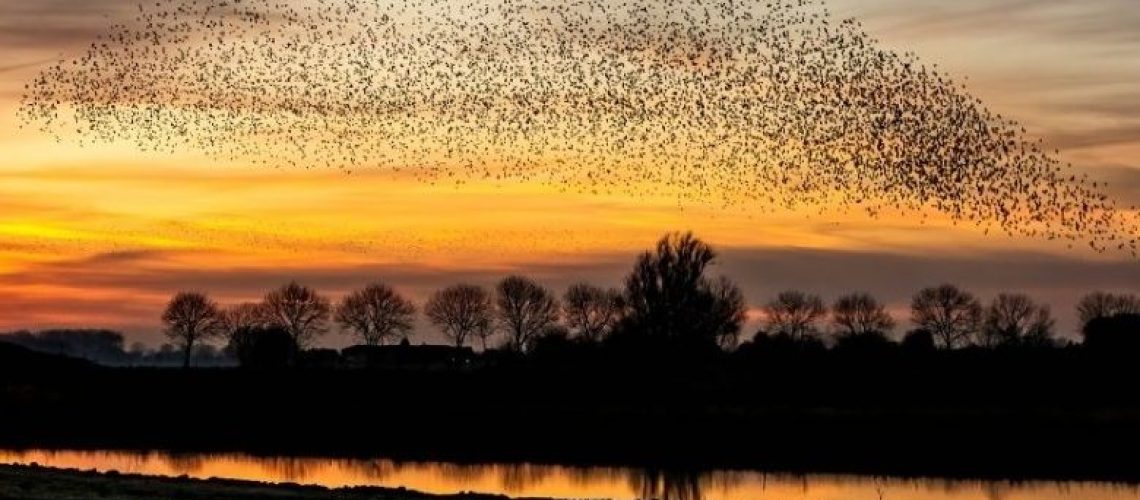
According to decades of research, with survival and thriving as their collective goal, starlings murmurate, engaging in three simple habits that allow thousands of birds to move as one. Each individual bird displays a leaderful mindset and agency to survive and thrive using these habits:
STEP UP – Each bird pays attention and takes initiative when needed.
STEP BACK – Each bird makes space for others to contribute and be leaderful.
STEP TOGETHER – Each bird coordinates with those closest to them, flying united.
Researchers call this Flock Logic—the simple rules that allow thousands of individuals to move as one intelligent system, with each bird being leaderful. All are capable of leading and are given agency to make decisions for the team. No one leader is in control.
These habits allow starlings to shift from acting as isolated individuals (ME) to connecting with their nearest neighbors (WE) to moving as a unified flock (US).
But how does each individual bird actually do this? Through three internal practices:
AWARENESS – The starling stays fully present and alert, sensing what’s happening right now, internally and externally. Threats (hawks) are always present in their environment.
BELIEFS – The starling remains flexible, updating its assumptions and subsequent behaviors based on what the environment is demonstrating in each moment.
CONNECT – The starling actively links with others, knowing that safety and purpose come through relationship and collective wisdom.
The habits (Step Up, Step Back, Step Together) are what starlings do. The practices (Awareness, Beliefs, Connect) are how they do it. Together, surviving and thriving is why they adopt this way of being. These are not separate goals, but interwoven into every movement.
The Survival System
Every living creature has a built-in survival system. Let’s call it your survival architecture. This system runs constantly in the background, monitoring for threats and opportunities through feedback loops that operate every millisecond. It distinguishes self from not-self, remembers past dangers, and triggers a stress response that overrides everything else when danger appears. The logic is simple: there’s no point optimizing for tomorrow if you don’t survive today.
Humans have this same “first, don’t die” imperative. Your body will sacrifice long-term thriving for immediate survival every time.
Here’s the problem: your survival system can’t always distinguish between a real threat and a perceived one. Many of the “dangers” triggering your stress response aren’t predators or physical harm. They’re limiting beliefs you’ve held onto for years. Learning to differentiate real threats from imagined ones is the key to unlocking your ability to thrive.
From Survival to Thriving
Starlings show us what becomes possible when survival needs are met. Through Flock Logic, thriving mechanisms naturally emerge once the flock feels safe.
The same is true for your body. When it’s not in defense mode, it doesn’t just maintain. It builds. Muscles strengthen with use. Neural pathways reorganize based on experience. Your microbiome shifts with diet. Sleep consolidates memories and clears metabolic waste. These are investments in future capacity, only possible when your body feels safe enough to grow rather than just defend.
The Cost of Chronic Stress
What’s fascinating is how your physical body, mind, and spirit navigate the tension between survival and thriving. Chronic stress, where your system remains in survival mode for too long, disrupts your thriving mechanisms.
You can’t digest well, sleep deeply, heal efficiently, or think clearly when your body believes it’s under threat. Your immune system gets confused. Inflammation becomes chronic. Your body spends all its resources on defense, leaving nothing for maintenance and growth.
When we’re stuck in chronic stress, the three practices break down. We lose AWARENESS, trapped in worry about the past or future instead of sensing the present. Our BELIEFS become rigid. We stop updating our assumptions even when the environment has changed. And we stop CONNECTING, withdrawing from the very relationships that could help regulate our system.
The Body's Generosity
But here’s where it gets interesting: your body is incredibly generous about what counts as “thriving.” It’s not just physical. When you form a relationship or connection with others, your system regulates. Conversations become transitional and transformational. The energy derived from connecting with others provides purpose and meaning that positively affects your immune function. Beauty and creativity engage, and healing begins.
Your body doesn’t distinguish between surviving a predator and surviving isolation. Both trigger similar stress responses. It doesn’t separate physical thriving from emotional or relational thriving. They’re all part of the same integrated system.
The Wisdom of the Continuum
Surviving and thriving aren’t an either/or switch. They’re a continuum your body is always navigating, allocating resources based on what it perceives you need most in each moment.
Starlings understand this instinctively. They’ve learned that survival doesn’t come from isolation and vigilance alone. It comes from connection. By linking with others, first with their nearest neighbors, then with the flock, they transform individual survival into collective thriving. The murmuration we witness in the sky is the visible result of thousands of small connections working together.
The invitation for us is the same: move from ME to WE to US. Step Up. Step Back. Step Together.
This starts with the inner work: staying AWARE of what’s actually happening, keeping your BELIEFS flexible, and remembering that you CONNECT to thrive.
When we do, we stop merely surviving and we begin to thrive, Murmurating with others.